Showing posts with label History. Show all posts

8.8.12

Gin Giminey Gin!

What is Gin?
“Gin” is a product obtained by original distillation from mash, or by re-distillation of distilled spirits, or by mixing neutral spirits, with or over juniper berries and other aromatics, or with or over extracts derived from infusions, percolations, or maceration of such materials, and includes mixtures of gin and neutral spirits. It shall derive its main characteristic flavor from juniper berries and be bottled at not less than 80° proof. Gin produced exclusively by original distillation or by re-distillation may be further designated as “distilled”.
                                                                   -by  Code of Federal Regulations 
                                                                   the United States


Genever a.k.a “ The Dutch Courage”
A word derived from French word “genie’vre” meaning juniper. A 17th century Dutch Physician, Dr. Franciscus De Le Boe’ Sylvius is credited to be the inventor of Gin when he added the oil of juniper to a base of neutral distilled spirits in order to find a cure for a stomach and kidney ailments , gout. He dubbed his tonic as a genever. The demand rose so high that Bols firm in Amsterdam started to market commercially.

What is Old tom gin?
Old Tom refers to a wide range of pre-London dry gins. In the early days. The gins used to be sweet and flavoursome botanicals to mask poor distillation technique.

What is Dry/London Dry?
In 1830, the invention of Aeneas Coffey / continuous Still by Aeneas Coffey and Robert Stein led to significant change in the production of much drier and purer gin.
London Dry Gin is the dominant English style of Gin in the United Kingdom, former British colonies, the United States, and Spain .It is a style of gin , has nothing to do with the geographical location, which derives its name from the pioneering work of London Distillers who produced a new style of gin ( back at that time) with a distinctive dry flavor than high in abundance old tom. Thus, it’s a FLAVOUR PROFILE THAN THE PRODUCTION LOCATION .It will tend to be juniper heavy on the flavour.

What is Bathtub Gin?
Referring to the prohibiton era (1920-1930’s) in U.S., bootleggers made a form of raw gin in a bathtub by “ Cold Compounding Process” of infusing the neutral cheap, vicious, vile spirits with juniper.

Navy Strength gin
The gin especially created for great Britain’s Royal Navy, high proof. The traditional navy strength gin had 57% abv.
New western style gin/” Botanicals Democracy”
It won’t have Juniper dominant profile, like newly launched brand ,grapefruit and coconut flavoured Hoxton gin , rose petal and cucumber forward Hendricks and Aviation gin for lavender, cardamom, which started the new classification( New western style gin) on the types of gin. But it MUST contain Juniper to be called gin.

What is Sloe gin?
Blackthorn berries macerated in gin and sugar is all that’s needed to make sloe gin. It’s not really a gin in the classical sense, but more of a liqueur with a gin base.

For more on Gin Bourbon & Chimes

8.7.11

Chasing the Green Fairy.

At the end of the 18th century, Pierre Ordinaire - a French doctor while living in Switzerland , used wormwood (Artemisia absinthium or grande wormwood, an ancient medicinal plant with a variety of uses particulary for stomach and digestive complaints) together with anise, fennel, hyssop and various other herbs distilled in an alcoholic base as a herbal remedy for his patients. Ordinaire’s recipe eventually found its way into the hands of Henri-Louis Pernod who established the Pernod fils dynasty when he opened his first distillery in 1805, and very soon ‘Extrait d’absinthe. 

This spirituous liquor that rose to excessive popularity in France and Switzerland beginning in the 18th century (amongst infamous in artists and Moulin Rouge bohemians including Baudelaire, Rimbaud, Apollinaire,Verlaine,Vincent Van Gogh, and Pablo Picasso used it for intoxicating, hallucinogenic and erotic effects.) People used to meet for an absinthe at so called “Green Hour” in the late afternoon or prior to meal.
It is an anise and wormwood flavored spirit, distilled from anise, fennel , absinthium wormwood, petite wormwood (Artemisia pontica), melissa (Melissa officinalis) and hyssop (Hyssopus officinalis), angelica root, sweet flag, dittany leaves, star-anise fruit and mint lemon balm,juniper, nutmeg veronica…..  Absinthe takes its name from the main adjunct flavoring aside from anise, Artemisia absinthium, the common French name for which is “grande absinthe”. it is often referred to as a “liqueur”, this isn't really accurate today, since according to the modern definition of liqueurs they are pre-sweetened and absinthe is not. Technically, absinthe is an aperitif spirit.  Pre-sweetened absinthe was a liqueur known as crème d'absinthe and was of lower proof.


Absinthe is very high in alcohol content, usually in the 55% to 72% range (110 to 144 proof); for comparison, whisky is generally around 40%, or 80 proof. Absinthe, a high-proof concentrate, is intended to be served diluted with iced water at a ratio of approximately three to five parts water to one part absinthe.  The flavor of absinthe is often associated with black licorice.  The reason for this is that many licorice candies are actually flavored with star anise oil, the inexpensive flavoring  used in lower quality absinthes.  Premium absinthes use primarily green anise—the common aniseed—which has a much more balanced and mellow flavor and sometimes use whole star anise sparingly to supplement the green anise. The licorice plant and green anise are unrelated. The flavor of licorice root—Glycyrrhiza glabra—comes from the compound glycyrrhizin, while that of anise, fennel and star anise come from anethole.   It comes in various shades of Green in colour because of High concentrations of chlorophyll.


Absinthe is a simple drink. Proper preparation consists of slowly diluting it with very cold iced water—whether dripping from a specially made absinthe fountain to a ratio of approximately three to five parts water to one part absinthe, and sweetened to taste. The botanical oils from the anise and fennel do not mix with water but are readily dissolved in the high-proof alcohol during the distillation process. When absinthe is diluted with water, the oils from the anise and fennel come out of solution with the alcohol to form a colloidal suspension (microscopic oil droplets) with the water, causing a beautiful cloudy effect, known as the “louche.”  “Louche” is a French word (pronounced “loosh”) meaning variously, “turbulent” “troubled” and “cloudy.”
One should never drink absinthe neat.  First of all, it's too strong.  More importantly, many of the aromas and flavors are not present until the addition of water brings the herbal oils out of solution and the flavor “blooms.” 


Source: Wikipedia, Pinterest, Tumblr, http://www.wormwoodsociety.org/

18.5.11

The Constante Daiquiri.


The bar , La Florida later El Floridita was opened in 1819. It was called La Piña de Plata "The Silver Pineapple". Located next to one of the old city gates of the former “Villa San Cristóbal de La Habana”, so to speak, the “complete” description of Havana. In the early days of The Silver Pineapple, it used to mainly attract dandies, musicians, artists, military, patrons, etc. The first U.S. military invasion was this bar and the starting point for American alcohol connoisseurs. After 1902, when Cuba became a republic, the bar got the name LA FLORIDA to EL FLORIDITA.


Constante – the inventor of frozen daiquiri, were born in Catalonia, Spain. He came to Cuba in 1924, and joined the Floridita bar in 1928 along with two other waiters. Constante later took large loans and bought off the Floridita bar from the two partners and became the sole owner. The name Ernest Hemingway goes synonymously with Cuba and it isn't a surprise that Hemingway dedicated his favorite bartender in his novel "Islands in the South" to Constante - a character named "Constant".
He was the undisputed "King of Cocktails". At his death in 1952, wrote Ernest Hemingway: "The master of all barmen is dead. He invented Floridita ... "


Image: Original-Daiquiri-recipe from Mr. Cox to Facundo Bacardi - BACARDI ARCHIVES MIAMI


“Origin is disclosed of Daiquiri Cocktail
One Group of American Engineers Named Drink at Santiago Bar
During prohibition Havana was the mecca for Americans
One day, a group of American engineers who had come into town from the Daiquiri mines were imbibing their favorite drink in this restful spot. It was one of those wonderful rum concoctions made from Ron Bacardi. A jovial fellow by the name of COX spoke up. „Caballeros Y amigos, we have been enjoying this delicious mixture for some time, but strange to admit the drink has no name. Don‘t you think it is about time something was done to extricate us from this sad predicament“ It was unanimously agreed that the drink should be named without further procrastination. There was silence for several minutes as each man became immersed in deep though. Suddenly Cox‘s voice was heard again. „I have it, men! Let‘s call it the Daiquiri“ And so it was christened. Originally it was a tall drink, the glass being packed with cracked ice and a teaspoonful of granulated sugar poured over the ice. The juice of one or two limes was then squeezed in and two or three ounces of Bacardi added. The glass was frosted by stirring a long handled spoon for serveral minutes..."

Daiquiri
Cuban light Rum 60 ml
Fresh Lime juice 25 ml
Granulated sugar 1.5 
Bar-spoon
Add sugar and lime juice.stir to mix and taste. 

Add ice and a large portion of Rum.Shake and double strain on a chilled coupette glass. 
Garnish- Float a thinly sliced lime wheel.
note: the amount of ingredients should be in descending order, so u taste more rum, followed by lime which is binded and softened with a hint of sweetener and the dilution that comes from shaking with ice)

Hemingway Daiquiri
Light Rum 2 oz
Fresh lime juice 0.25 oz
Fresh grapefruit juice 0.5 oz
Sugar 1 tsp
Luxardo Maraschino liqueur 1 tsp
Shake and strain on a chilled coupette glass. (But Hemingway liked his with no sugar and blended version)
Source: Club de Cantineros

26.4.11

The Tiki Bar.


Originally , referred to a carved statue representing Polynesian god. It brings the image of exoticism, fantasy, mysticism, laid back life Polynesian lifestyle, hula girls, Hawaiian Tattoos burning torches…thanks to CBS-TV series Gilligan's Island..
The Tiki bar was more or less American’s escape from the depression. The tales brought back by returning soldiers after serving in Southern Pacific (WWII) and the uprising of the middle class as an economic force in post war era helped tiki to bloom.
Don the Beachcomber (Feb22,1907-June7,1989) & Trader Vic (Dec, 1902-Oct11,1984)

Donn Beach, a former Texan bootlegger during prohibition, served in WWII, famously known to open a bar and restaurant called Don Beachcomber in 1934 in Hollywood California serving Cantonese dishes with mysterious drinks like Zombie, Navy Grog, scorpion bowls and many others..
Victor Jules Bergeron Jr., founder of restaurant called Trader Vic’s is one of the two who claims to have invented The Mai Tai.

Don the Beachcomber Zombie
Lime juice 0.75 ml
Grapefruit cinnamon syrup 15 ml
Pineapple juice 45 ml
Falernum 15 ml
Jamaican rum 30 ml
Gold rum 30 ml
151 Demerara rum 30 ml
Maraschino liqueur 15 ml
Absinth 6 drops
Grenadine 1/8
Bitters dash
Blend for about 5 seconds with few ice to mix and to aerate the pineapple juice. Pour into a tall glass and garnish with a big sprig of mint.
Trader Vic's Mai Tai
17-year-old rum imported by J. Wray & Nephew 60ml
Dry orange curacao 15ml
Lime juice 22.75ml
Orgeat 7.5ml
Rock candy syrup 7.5ml
Shake and strain on a rock glass over crushed ice. Garnish With a mint sprig (the drink should be beige in colour)
Bars like Pain killer (from Guiseppe Gonzales and Richard boccato), Julie Reiner’s headed Lani Kai and Smuggler’s Cove in SFO are to be looked up for the revival of Tiki... Jeff “Beachbum” Berry is a noted rum expert, a tiki demi god known for his dedication to tiki drinks.
Read up more on the Tiki Research by Painkiller, HERE.


Source: Tikipop, Humuhumu.com

19.4.11

The Blind Pig.

Prohibition Style Hen Party
cakes and sandwiches with teapot cocktailsLooking for ideas for holding hen parties in Glasgow?   Wedding Ideas likes the sound of “Tea Time Martinis” at theIntoxicating Tearooms.
It’s afternoon tea with a twist – vintage teapots brimming with an array of delicious cocktails, served with scrummy cakes and sandwiches.   The Intoxicating Tearooms are inspired by the prohibition era secret speakeasies of New York.  Think “The Cotton Club” and you get the idea. 
Inside you’ll feel like you’ve taken a step back in time to the 1920′s and 1930′s. 
tea time cocktails poured from teapot   tea cup style cocktails
The in-house mixologists make your cocktail teapots to order – choose from delights like; “Espresso Martini”, “Strawberry Cream Tea”, “For All The Tea in China”.  They’ll explain how to create the delectable drinks, giving everyone a hands-on experience making the cocktails themselves.   “Tea Time Martinis” is £15 per person (or per hen should we say) and includes cakes, sandwiches and your teapot cocktail! 
The hen party will also be able to decorate their own cupcakes, with advice on how to make them look just right.
“A hen party is all about indulgence and treating the bride-to-be and what better treat than a day filled with food, drink and an activity to enjoy before hitting Glasgow’s fantastic bars and clubs” says Brad Stevens, owner of The Blind Pig (of which The Intoxicating Tearooms is a part).   
(All photography supplied by Blind Pig.)  We’ve also got plenty of other hen party ideas on the Wedding Ideas magazine blog.
Source: weddingideasmag.com

16.4.11

Raising the Bar.


Simple, taverns or inns frequented by the labourers after long hard day,were said to have barricade their fragile products against vandalism from the frequently brawling alcohol consumer; hence the word bar.
Around 1800,Salon came into common use for the establishment probably the the derivation from the Italian word. The customers were primarily male and no respectable woman would have been seen in there.
Nearing 19th century,the word bar started to open its wings and to be seen in the better hotels in prosperous cities,rapidly becoming the expression of new attitude of life. In between American Revolution and Prohibition(1920-1933), the art of bartending was born and started to spread its wings...


The first bar book ,"The bartender's guide" was published in 1862 containing the rules of the conduct for the bartender and handy selections of recipes including punches, cobblers, flips, fix, juleps, sangaree, sour, shrub, crusta, pousse-café ...etc by Jerry P.Thomas.


In 1856,Knickerbocker Magazine ,Charles G. Leland had referred bartender as mixologist of tipulars fixings ...
who can forget the contribution of hotel bars in the history of cocktail making...like Sidecar from The Ritz Carlton (Paris);The Monteleone(New Orleans) for Vieux carre;The St.Regis (NYC) , King Cole bar for Red Snapper /bloody Mary.The St,Regis -King Cole bar claims their french bartender Fernand Petiot invented the Red Snapper known as Bloody Mary in 1934 but Harry's New York bar (Paris) also claims to have invented the drink.The Waldrof -Astoria-(Nyc)-for Rob Roy..and The Great Savoy with numerous libations..


Bloody Mary with a Twist.

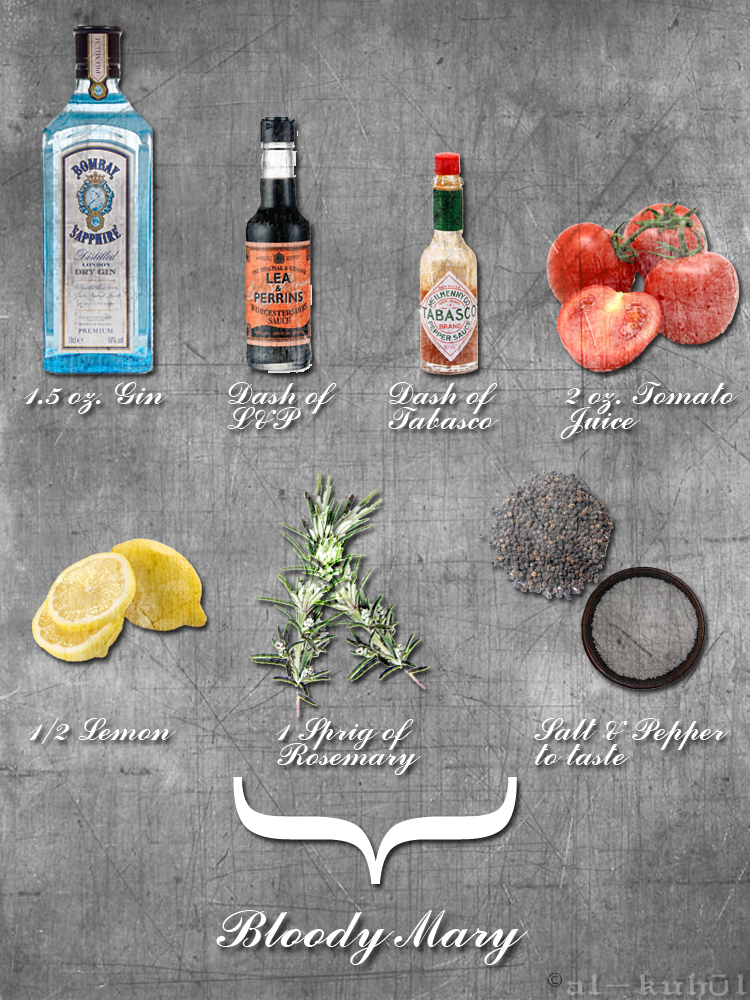
After a long week, there is nothing like a Saturday brunch with a home made Gin Bloody Mary with a twist of Rosemary.


What You will Need:
Image by: richa
Voila!
Image by: richa
Mix all the ingredients in a tall glass filled half way with ice. Pour the mixture back and fourth a few times to bind all the ingredients together. Top it off with more ice and a slightly bruised Rosemary sprig. ENJOY!

Here is an interesting article we came across about Bloody Mary...

Cocktail Chemistry: Parsing the Bloody Mary
by ADAM COLE
You have no idea what's going on in that glass.
Enlargekillthebird/Flickr
You have no idea what's going on in that glass.
The bloody mary, the signature brunch cocktail, had a friend in Ernest Hemingway. The famous writer bragged in a letter to Bernard Peyton that he introduced the drink to Hong Kong, and further claimed that "it did more than any other single factor except perhaps the Japanese Army to precipitate the fall of that Crown Colony."
I don't know about that, but the bloody mary does seem to hold a special place on the menu. It at least appears to be a healthier option than most drinks (it's mostly tomato juice, right?), and it's often touted as a hangover remedy. So how do you make the perfect bloody mary?
Hemingway's recipe involved a lot of "tasting-as-you-go", and a long list of ingredients: vodka, tomato juice, Worcestershire sauce, lime juice, celery salt, cayenne pepper (modern bartenders usually substitute Tabasco sauce) and black pepper.

"Each of those ingredients has tens of compounds, if not hundreds of compounds," Neil Da Costa, an analytic chemist working for International Flavors and Fragrances, tells Shots. "The bloody mary has been called the world's most complex cocktail."
He should know. Da Costa has used every trick in the chemist's book to analyze each ingredient, and the cocktail as whole. He presented his findings at a meeting of the American Chemical Society this week. Da Costas, an expert in food flavors, is chairman-elect of the group's agriculture and food chemistry division.
With gas and liquid chromatography, Da Costa isolated the wide variety of compounds that give the bloody mary its unique flavor. The drink covers much of the taste spectrum: sweet, salty, sour and umami — the savory taste of glutamic acid.
A visualization of the flavors in a typical bloody mary
EnlargeAdam Cole/NPR
A visualization of the flavors in a typical bloody mary
And, Da Costa says, the order of these sensations is appealing: first cool and refreshing, then spicy, and finally a sinus-clearing horseradish kick.
So what lessons can amateur bartenders glean from all this analysis? Make it fresh and make it cool, Da Costa says. Many of the ingredients are chemically unstable, so it's important to make your bloody mary from fresh ingredients and keep it iced to prevent deterioration.
Hemingway would agree. He jotted down at the bottom of his recipe, "Whole trick is to keep it very cold."
He went on to observe: "You can mix it so it will taste as though it had absolutely no alcohol of any kind in it and a glass of it will still have as much kick as a really good big martini."
So if you're aiming for that perfect bloody mary, splurge on the tomato juice, not the vodka. You might not even taste the cheap alcohol.
Neil presented his findings as part of the International Year of Chemistry a "worldwide celebration of the achievements of chemistry" organized by the UN and International Union of Pure and Applied Chemistry.
"This was done to try and get chemistry to the masses," Da Costa says. "Anything you eat or anything you do - everything involves chemistry."

Erik Lorincz's Bloody Mary.

To work behind the same bar as Harry Craddock, the man who published the definitive Savoy Cocktail Book in 1930, is the dream for many bartenders, and Erik Lorincz is the latest high profile barman to live that dream. After outperforming 9000 bartenders to win the 2010 Diageo World Class Competition, a Wall Street Journal writer wondered whether that made him “the best bartender in the world.” Best or not, he did become head bartender at the famed American Bar at the Savoy Hotel, which reopened after some fine tuning on 10.10.10.

Bourdain in Japan.
 
Muchacha Caliente.


Source: npr.org, foodgps.com